Showing posts with label India. Show all posts
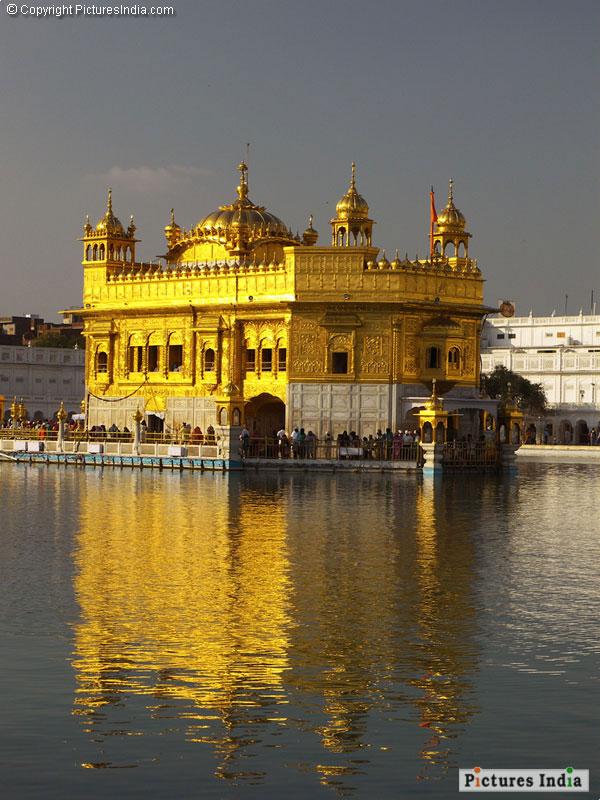
The Golden Temple, located in the city of Amritsar in the state of Punjab,is a place of great beauty and sublime peacefulness. Originally a small lake in the midst of a quiet forest, the site has been a meditation retreat for wandering mendicants and sages since deep antiquity. The Buddha is known to have spent time at this place in contemplation.Two thousand years after Buddha's time, another philosopher-saint came to live and meditate by the peaceful lake. This was Guru Nanak (1469-1539), the founder of the Sikh religion. After the passing away of Guru Nanak, his disciples continued to frequent the site; over the centuries it became the primary sacred shrine of the Sikhs. [Source]
At least that's true if you live on a kettuvallams or Kerala houseboat, which are famous to this area. You can travel in the backwaters or brackish lagoons and lakes parallel to the Arabian Sea coast in southern India. [Source]
Vidhana Soudha counts amongst the most impressive as well as the most magnificent buildings in the Bangalore city of India. It is mainly famous for housing the Legislative Chambers of the state government. The three hundred rooms of Vidhan Soudha accommodate approximately twenty-two departments of the state government. The building rises to a height of almost 46 m, making it one of the most imposing structures in the city of Bangalore. [Source]
The Cellular Jail, also known as Kālā Pānī, was a colonial prison situated in the Andaman and Nicobar Islands, India. The prison was used by the British especially to exile political prisoners to the remote archipelago. Many notable freedom fighters such as Batukeshwar Dutt and Veer Savarkar, among others, were imprisoned here during the struggle for India’s independence. Today, the complex serves as a national memorial monument. [Source]
Qutub-ud-din Aibak laid the foundation for Qutub Minar in 1199 AD and his successor and son-in-law Shamsu’d-Din- Iitutmish completed the structure by adding three more stories. Standing at 72.5 meters, it is the highest stone tower in India. Its base diameter is 14.3 meters and its top diameter is 2.7 meters. It has 379 steps leading to its top story. [Source]
Sanchi is a small village in Raisen District of the state of Madhya Pradesh, India, it is located 46 km north east of Bhopal, and 10 km from Besnagar and Vidisha in the central part of the state of Madhya Pradesh. Known for its "Stupas". The 'Great Stupa' at Sanchi is the oldest stone structure in India and was originally commissioned by the emperor Ashoka the Great in the 3rd century BCE. Its nucleus was a simple hemispherical brick structure built over the relics of the Buddha. [Wiki]
Presently a laid back village, Hampi was at one time the final capital of Vijayanagar, one of the most stupendous Hindu realms in India’s history. It has some amazingly enamoring destroys, intriguingly intermixed with extensive stones that back up everywhere on the scene. The vestiges, which go back to the 14th century, extend for a little more than 25 kilometers (10 miles) and embody more than 500 landmarks. [Source]
The Lakshmana Temple is a Hindu temple located in Khajuraho, India. Dedicated to Vaikuntha Vishnu - an aspect of Vishnu, it was built by the Chandela Ruler Yashovarman during c. 930-950 CE. The sanctum doorway is of seven sakhas (vertical panels). The central one being decorated with various incarnation of Lord Vishnu. The Lintel depicts goddess Lakshmi in the centre flanked by Brahma and Vishnu. The sanctum contains four-armed sculpture of Vishnu.  [Wiki]
At that point you have the Umaid Bhavan Palace that is placed in the city of Jodhpur in the Indian state of Rajasthan. This is around five kilometres from the Jodhpur airfield and is one of the most amazing places on the planet. A regal touch and rich feeling is what welcomes you when you drop in Jodhpur. Add to this the excellence of yesteryears and the greatness of a time that is still living to let it know tale and you have the best of buildings here in this city. [Source]
The charminar Hyderabad’s best known landmark was built 1591 by Sultan Mohammed Quli Qutub Shah to appease the force of evil savaging his new city with epidemic and plague. Standing in the heart of the old walled city and surround by lively bazaars, the charminar (‘four tower’) is a 56m high triumphal arch. [Source]
The Palace of Mysore (also known as the Amba Vilas Palace) is a palace situated in the city of Mysore in southern India. Mysore is commonly described as the City of Palaces, however, the term "Mysore Palace" specifically refers to one within the old fort. The Wodeyar kings first built a palace in Mysore in the 14th century, it was demolished and constructed multiple times. [Wiki]
Hawa Mahal, is a palace in Jaipur, India. Its unique five-storey exterior is also akin to the honeycomb of the beehive with its 953 small windows called jharokhas that are decorated with intricate latticework. Built of red and pink sandstone, the palace is situated on the main thoroughfare in the heart of Jaipur’s business centre. It forms part of the City Palace, and extends to the Zenana or women's chambers, the chambers of the harem. It is particularly striking when viewed early in the morning, lit with the golden light of sunrise. [Wiki]
Vijay Stambha or "Tower of Victory" is an imposing structure located in Chittorgarh fort in Rajasthan, India. The inscribed slabs in the uppermost story contains genealogy of the rulers of Chittaur from Hamir to Rana Kumbha. The entire tower is covered with architectural ornaments and inscribed images of gods and goddesses, seasons, weapons, musical instruments, etc. Its inscribed sculpture are a veritable text-book of Hindu iconography. [Wiki]
Elephanta Island also called Gharapuri Island or place of caves is one of a number of islands in Mumbai Harbour, east of Mumbai, India. This island is a popular tourist destination because of the island's cave temples, the Elephanta Caves, that have been carved out of rock. There is also a narrow-gauge toy train from the boat area on the dock to the base of the steps leading up to the caves (about 600 meters). Along the path, hawkers sell souvenirs like necklaces, anklets, showpieces and keychains. [Wiki]
Chand Baori is a famous stepwell situated in the village of Abhaneri near Jaipur in the Indian state of Rajasthan. Chand Baori was built by King Chanda of the Nikumbha Dynasty between 800 and 900 CE and was dedicated to Hashat Mata, Goddess of Joy and Happiness upon completion. It is located opposite Harshat Mata Temple and was constructed in 800 CE. Its 3500 narrow steps in 13 stories extend 100 feet (30 m) into the ground, making it one of the deepest (and largest) stepwells in India. [Wiki]
Ellora also known as Ellooru, is an archaeological site, 29 km (18 mi) North-West of the city of Aurangabad in the Indian state of Maharashtra built by the Rashtrakuta dynasty. The 34 "caves" – actually structures excavated out of the vertical face of the Charanandri hills. Well known for its monumental caves, Ellora is a World Heritage Site. The 12 Buddhist (caves 1–12), 17 Hindu (caves 13–29) and 5 Jain (caves 30–34) caves, built in proximity, demonstrate the religious harmony prevalent during this period of Indian history. [Wiki]
Christ Church, Shimla, is the second oldest church in North India. Built in the neo-Gothic style in 1857 to serve the largely Anglican British community in what was formerly called Simla, Christ Church is situated on The Ridge where is stands out as one of the prominent landmarks of Shimla. Christ Church was designed by Colonel J. T. Boileau in 1844, and the church was consecrated after 1857. The clock adorning Christ Church was donated by Colonel Dumbleton in 1860. The porch was added in 1873. [Wiki]
The Taj Mahal is a white marble mausoleum located in Agra, Uttar Pradesh, India. Taj Mahal is regarded by many as the finest example of Mughal architecture. In 1631, Shah Jahan, emperor during the Mughal empire's period of greatest prosperity, was grief-stricken when his third wife, Mumtaz Mahal, died during the birth of their 14th child. [Wiki]
Jaipur is the capital and largest city of the Indian state of Rajasthan. The city today has a population of 3.1 million. The city is remarkable among pre-modern Indian cities for the width and regularity of its streets which are laid out into six sectors separated by broad streets 34 m (111 ft) wide. [Wiki]
The baobab is found in the savannas of African and India, mostly around the equator. It can grow up to 25 meters tall and can live for several thousand years. The baobab is leafless for nine months of the year. [Source]