Showing posts with label Temple. Show all posts
The Royal Temple of Mengwi is one of the most important temples in Bali. Built in 1634 by a King of the Mengwi dynasty, this impressive complex stands on an island in a river, its inner temple surrounded by a moat. Its Balinese name Pura Taman Ayun literally means ‘Garden Temple in the Water’. [Source]
Some 20 kilometers South of Pattaya lies the enormous Wat Yansangwararam Temple complex. Set in a huge area of around 145 acres, the complex houses several buildings of very different architectural styles, as well as well kept gardens and a large lake, that make the complex a nice and peaceful place to relax. [Source]
Over the past 11 years, the Temple at Burning Man has evolved and grown to become a place of reflection, of remembrance and letting go; a place of union, gathering, and peacefulness. From every corner of the Burning Man Community, an International Arts Megacrew is coming together to create this year's Temple for our desert family - The Temple of Transition. [Source]
Wat Rong Khun is a contemporary unconventional Buddhist temple in Chiang Rai, Thailand. It was designed by Chalermchai Kositpipat. Construction began in 1996 and is expected to be completed in 2070. [Source]
It's also known as "Temple of the Emerald Buddha." Adjoining the Grand Palace, the temple is the greatest spectacle of Bangkok. There are over 100 brightly-colored buildings, all unique unto themselves. Built in 1782 during Rama I's reign, the Emerald Buddha, which gives it its name, is traced to India, centuries after Lord Buddha attained Nirvana and then had it enshrined in Bangkok. [Source]
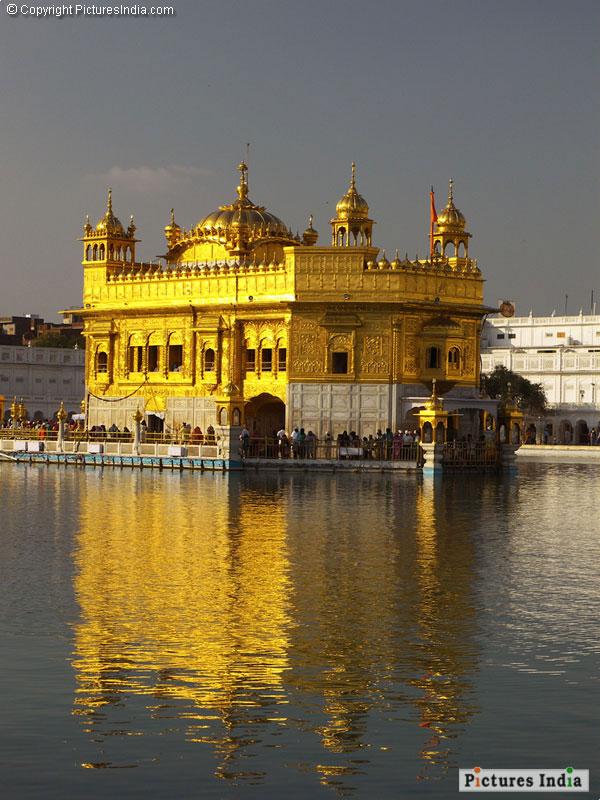
The Golden Temple, located in the city of Amritsar in the state of Punjab,is a place of great beauty and sublime peacefulness. Originally a small lake in the midst of a quiet forest, the site has been a meditation retreat for wandering mendicants and sages since deep antiquity. The Buddha is known to have spent time at this place in contemplation.Two thousand years after Buddha's time, another philosopher-saint came to live and meditate by the peaceful lake. This was Guru Nanak (1469-1539), the founder of the Sikh religion. After the passing away of Guru Nanak, his disciples continued to frequent the site; over the centuries it became the primary sacred shrine of the Sikhs. [Source]
AbsoluteVisit is the majestic obelisk standing tall in front of the temple. There used to be two, but the other was donated to King Louis V in 1874 and now resides in Paris. Then the long stretch of walls and statues take you on a time travel back to a succession of pharaohs. Once you've reached the Court of Amenhotep III, you've arrived at the oldest part of the temple, where columns from the 13th century still stand high and strong for you to admire. [Source]
The Lakshmana Temple is a Hindu temple located in Khajuraho, India. Dedicated to Vaikuntha Vishnu - an aspect of Vishnu, it was built by the Chandela Ruler Yashovarman during c. 930-950 CE. The sanctum doorway is of seven sakhas (vertical panels). The central one being decorated with various incarnation of Lord Vishnu. The Lintel depicts goddess Lakshmi in the centre flanked by Brahma and Vishnu. The sanctum contains four-armed sculpture of Vishnu.  [Wiki]
The principal temple of the Angkorian region, Angkor Wat, was built between 1113 and 1150 by King Suryavarman II. Suryavarman ascended to the throne after prevailing in a battle with a rival prince. An inscription says that, in the course of combat, Suryavarman leapt onto his rival's war elephant and killed him, just as the mythical bird-man Garuda slays a serpent. [Source]
Wat Arun is a Buddhist temple in the Bangkok Yai district of Bangkok, Thailand, on the Thonburi west bank of the Chao Phraya River. A Buddhist temple had existed at the site of Wat Arun since the time of the Ayutthaya Kingdom. It was then known as Wat Makok, after the village of Bang Makok in which it was situated. [Wiki]
Temples are the places of worship in Japanese Buddhism. Virtually every Japanese municipality has at least one temple, while large cultural centers like Kyoto have several thousands. Temples store and display sacred Buddhist objects. Some temples used to be monasteries, and some still function as such. [Source]
In many resource-throwing or ancient inscriptions, there are three large bag that is often mentioned as well and Ulun Danu Batur Besakih, Pura ie Lempuyang. Pura Luhur Lempuyang located on top of Mount Bisbis or Lempuyang, Karangasem. Pura is thought to include the elderly in Bali. fact , is estimated to have existed in the pre-Hindu-Buddhist sacred buildings made ​​of stone. Pura Lempuyang was Stana GNI Jaya or deity Hyang Iswara. [Source]
The Guanyin of the South Sea of Sanya is a 108-metre (354 ft) statue of the bodhisattva Avalokiteśvara (better known as Guanyin in East Asia), sited on the south coast of China's island province Hainan near the Nanshan Temple of Sanya. The statue took six years to build and was enshrined on April 24, 2005, with the participation of 108 eminent monks from various Buddhist groups in Taiwan, Hong Kong, Macao and Mainland China, and tens of thousands of pilgrims. This is currently the fourth tallest statue in the world (many of which are Buddhist statues) and the tallest statue of Guanyin in the world. [Wiki]
Elephanta Island also called Gharapuri Island or place of caves is one of a number of islands in Mumbai Harbour, east of Mumbai, India. This island is a popular tourist destination because of the island's cave temples, the Elephanta Caves, that have been carved out of rock. There is also a narrow-gauge toy train from the boat area on the dock to the base of the steps leading up to the caves (about 600 meters). Along the path, hawkers sell souvenirs like necklaces, anklets, showpieces and keychains. [Wiki]
Tikal Temple I is the designation given to one of the major structures at Tikal, one of the largest cities and archaeological sites of the pre-Columbian Maya civilization in Mesoamerica. The structure is a funerary temple associated with Jasaw Chan K'awiil I, a Classic Period ruler of the polity based at Tikal, who ruled from AD 682–734. Temple I is a typically Petén-styled limestone stepped pyramid structure that is dated to approximately 732 AD. The temple rises 47 meters (154 ft) over the Great Plaza. [Wiki]
Mount Cangyan is a scenic area in Jingxing County, Hebei Province, China. The most famous building complex on Mount Cangyan is the Fortune Celebration Temple. It was first erected during the Sui Dynasty and is said to have been the place where Princess Nan Yang, the daughter of the Sui Emperor Yang, practiced Buddhism. Mount Cangyan forms the eastern tip of the Taihang Mountain Range, its tallest peak has an altitude of 1,000 meters. [Wiki]
The Shwedagon Pagoda officially titled Shwedagon Zedi Daw, also known in English as the Great Dagon Pagoda and the Golden Pagoda, is a 99 metres (325 ft)gilded pagoda and stupa located in Yangon, Burma. According to legend, the Shwedagon Pagoda has existed for more than 2,600 years, making it the oldest historical pagoda in Burma and the world. It is the most sacred Buddhist pagoda for the Burmese with relics of the past four Buddhas enshrined within: the staff of Kakusandha, the water filter of Koṇāgamana, a piece of the robe of Kassapa and eight strands of hair from Gautama, the historical Buddha. [Wiki]
Chand Baori is a famous stepwell situated in the village of Abhaneri near Jaipur in the Indian state of Rajasthan. Chand Baori was built by King Chanda of the Nikumbha Dynasty between 800 and 900 CE and was dedicated to Hashat Mata, Goddess of Joy and Happiness upon completion. It is located opposite Harshat Mata Temple and was constructed in 800 CE. Its 3500 narrow steps in 13 stories extend 100 feet (30 m) into the ground, making it one of the deepest (and largest) stepwells in India. [Wiki]
Kiyomizu-dera officially Otowa-san Kiyomizu-dera is an independent Buddhist temple in eastern Kyoto. Kiyomizu-dera was founded in the early Heian period. The temple was founded in 798, and its present buildings were constructed in 1633, ordered by the Tokugawa Iemitsu. [Wiki]
The Chinese told their emperor that the Khmers were already a powerful race, and should a naga appear through the cavern of Arthross, they would be strong enough to rule the world. The Chinese emperor did not want this, nor did he want a war. Instead, he asked the Khmer king if he could build a temple above the cavern, with the Buddha's face towards China in order to protect his empire. [Source]